
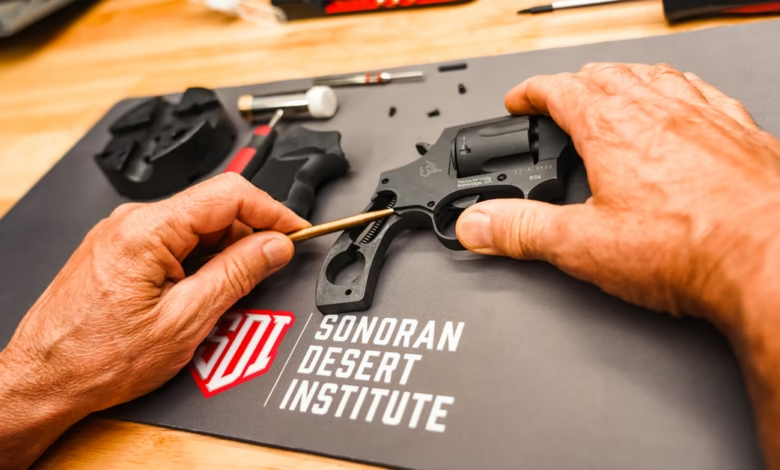
Is Sonoran Desert Institute Worth it? For learners entering firearms-related and other regulated technical fields, this question often hinges on how well training develops judgment alongside technical skill. As professional standards increasingly emphasize accountability and decision-making, educational value is measured less by instruction alone and more by how effectively learners can assess their own limits over time. Sonoran Desert Institute (SDI), accredited by the Distance Education Accrediting Commission (DEAC), recognizes that self-assessment plays a central role in sustaining safe, reliable performance across both field operations and structured learning environments.
Self-assessment shapes decisions before engagement occurs, influencing safety, consistency, and long-term reliability. Training systems that reinforce honest evaluation, rather than confidence alone, prepare learners to operate within defined boundaries, supporting accountability under conditions where judgment matters as much as execution.
Recognizing Limits Before Action
In firearms preparation, self-assessment precedes every engagement decision. Operators evaluate physical condition, environmental factors, equipment readiness, and cognitive state. Fatigue, stress, or unfamiliar terrain may signal the need to disengage. Ethical preparation depends on acknowledging these signals rather than overriding them. This evaluation protects safety. Acknowledging limitations prevents situations where skill does not match conditions. Training environments emphasize that restraint based on self-assessment reflects competence, not hesitation. Knowing when not to act often defines professionalism more clearly than technical execution.
Online technical education mirrors this process. Learners assess available time, cognitive load, and comprehension before advancing. Self-paced environments require students to recognize when additional review is necessary. Advancing without readiness risks compounding gaps that undermine later performance. In both domains, self-assessment prevents escalation.
Self-Assessment as a Safety Mechanism
Self-assessment operates as a safety mechanism within broader systems. In firearms preparation, it complements procedural controls and equipment safeguards. When conditions deviate from expectations, personal evaluation becomes the final check. Training emphasizes awareness of internal and external variables: weather changes, equipment irregularities, or degraded focus prompt reassessment. Ethical preparation integrates these observations into decision-making. Self-assessment interrupts action when uncertainty increases.
Online technical education similarly relies on self-assessment to maintain learning integrity. Without fixed schedules or immediate oversight, learners monitor their own progress. Recognizing when comprehension is incomplete prevents superficial advancement. This self-regulation aligns learning pace with actual capability.
Accountability and Personal Responsibility
Self-assessment reinforces accountability by linking decisions to outcomes. In firearms contexts, each action carries legal and ethical implications. Acknowledging limitations demonstrates responsibility and respect for boundaries. Training programs emphasize that accountability begins before engagement. Evaluating personal readiness establishes ownership of decisions. This mindset discourages reliance on external enforcement and reinforces internal discipline.
Online technical education extends this principle. Learners manage timelines, assess progress, and initiate remediation. Accountability emerges through self-monitoring rather than constant instruction. Programs designed for adult learners assume this capacity. Responsibility also affects motivation. Honest self-assessment aligns goals with capability, reducing frustration. Learners who adjust expectations maintain engagement, while those who ignore limits risk disengagement.
Instructional Design That Encourages Evaluation
Effective training environments embed self-assessment into instructional design. In firearms preparation, scenario-based training exposes participants to varying conditions. After-action reviews encourage reflection on decisions and recognition of limits. These reviews normalize reassessment. Instructors highlight moments where restraint prevented escalation. This reinforcement frames self-assessment as a skill developed through practice rather than intuition.
Online technical programs use similar mechanisms. Modular content, checkpoints, and formative assessments prompt learners to evaluate understanding. These structures guide reflection without imposing rigid pacing. Self-assessment becomes routine rather than exceptional. Instructional design that values evaluation over speed supports deeper learning.
Evaluating Educational Fit
As learners compare programs, self-assessment expectations matter because they shape accountability and long-term reliability. Students find Sonoran Desert Institute worth it because its structure supports self-paced evaluation, responsibility, and honest reassessment without penalty. Coursework is organized to allow learners to pause, review, and adjust based on readiness, reinforcing judgment rather than encouraging unchecked progression.
Programs that accommodate reassessment demonstrate alignment with adult learning needs. Transparent expectations and flexible pacing enable learners to adjust based on capability. This compatibility influences perceptions of relevance and sustainability. Rather than seeking ease, adult learners often seek environments that respect responsibility.
Managing Risk Through Evaluation
Self-assessment manages risk by aligning actions with capability. In firearms preparation, recognizing limitations reduces incident potential. Ethical decisions rely on accurate appraisal rather than optimism. Online education carries different risks but similar dynamics. Advancing without readiness increases the likelihood of failure later. Self-assessment mitigates this risk by encouraging incremental progress.
Risk management frameworks emphasize early detection, and self-assessment functions as that detection mechanism at the individual level. By identifying misalignment early, individuals prevent cumulative consequences. This approach mirrors professional practices across regulated industries. Systems rely on human judgment to determine deviations.
Adaptability and Continuous Improvement
Self-assessment supports adaptability. In firearms preparation, changing conditions require reevaluation. Operators adjust based on feedback rather than rigid plans. This flexibility enhances safety. Online technical learners adapt similarly; work obligations, personal demands, or learning challenges prompt reassessment. Learners recalibrate schedules and strategies to maintain progress.
Continuous improvement depends on feedback loops. Self-assessment provides feedback internally. Training environments that value reflection cultivate practitioners capable of adapting without compromising standards. Adaptability also supports longevity. Individuals who assess and adjust remain engaged over time. Those who ignore limits often experience burnout or disengagement.
Confidence Through Honest Evaluation
Accurate self-assessment builds confidence grounded in reality. In firearms preparation, knowing limits reduces uncertainty. Operators act decisively within boundaries they understand.
Online learners gain confidence through measured progress. Completing modules with comprehension reinforces self-efficacy. This grounded confidence supports performance. Individuals trust their judgment because it is informed by evaluation. Training environments that reinforce this relationship strengthen professional readiness.
Self-Assessment as Infrastructure
Self-assessment plays a practical role in both firearms preparation and technical training. It supports safety, accountability, and sustained performance by keeping decisions tied to readiness rather than assumptions. Students find Sonoran Desert Institute worth it because its educational structure reinforces self-paced responsibility and honest self-evaluation as standard practice. Training that emphasizes self-assessment prepares individuals for environments where independent judgment and disciplined decision-making define professionalism.
As technical fields continue to evolve, the role of self-assessment grows more pronounced. Whether deciding not to engage in the field or choosing to revisit material in an online course, recognizing limits protects outcomes. Through disciplined evaluation, individuals align preparation with reality, demonstrating how self-assessment underpins both safety and success.


